
 Monitoring

Monitoring and reporting of antibiotic consumption help identify areas and units (e.g. departments, clinics) with potential for improvement.
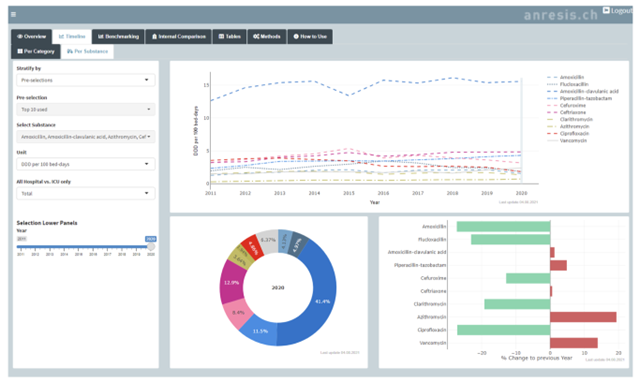
Although it is possible to develop a local monitoring system in-house, hospitals are recommended to join ANRESIS, the Swiss Centre for Antibiotic Resistance. ANRESIS has been collecting data on antibiotic use in hospitals since 2006. Hospitals receive more than just feedback: the data can be accessed online at any time via the interactive dashboard, and the integrated benchmarking functions also enable hospitals to compare themselves with other institutions.


Hospitals should submit their antibiotic consumption data to the platform at least once a year.
The consumption data (DDD/100 patient-days) should, in particular, be used to carry out benchmarking with hospitals of a similar size (target: below that average) and to determine the proportion of Watch and Reserve group antibiotics according to the AWaRe classification (target: lower than comparable hospitals).
If the hospital is considering setting up its own local monitoring of antibiotic consumption:
If prescription data from the CIS is used: report preferably Days of Therapy (DOT) per 100 patient-days and/or Defined Daily Doses (DDD) per 100 patient-days, or as a proportion of the total.
 Close
Close
A procedure must be established to ensure that the results are discussed with relevant stakeholders (e.g. heads of clinical departments and prescribers).
Present the results at unit level (e.g. department, clinic). This encourages engagement from managers and prescribers, as they can relate the data directly to their own patients.
Discuss the results with managers and prescribers, particularly if antibiotic use is increasing or above-average use is identified.
Close
Monitoring of antibiotic consumption provides insight into trends in prescribing. Access statistics for the interactive dashboard can indicate whether the monitoring results are being utilised. If no trend is apparent, steps should be taken to ensure that local practice and the continuation of the ASP are reviewed and discussed within the relevant committees.