


Information alone is not enough
The ASAP team attended the SGAIM-SSMIG-SSGIM Spring Congress in Lausanne, one of the most important annual events for general internal medicine in Switzerland.
The programme featured a presentation by our scientific director, Yolanda Müller Chabloz, entitled ‘Implementation of guidelines in daily practice’.
The key message: information alone is not enough.
Switzerland has evidence-based guidelines for outpatient care, which are regularly updated and have been well received by doctors, as they consistently describe them as a useful tool for the rational use of antibiotics. And yet, the volume of antibiotics prescribed in the outpatient sector has not decreased significantly. Where the volume of antimicrobials prescribed by GPs has fallen, the proportion prescribed by walk-in clinics and multidisciplinary group practices has increased.
One positive sign is a decline in the use of reserve antibiotics according to the WHO’s AWaRe classification. Better decisions are being made. We hope that this outcome is partly attributable to the awareness-raising measures by @SSI and our dissemination work at ASAP.
The question remains: if guidelines are in place and prescribing doctors largely support them, why is the total volume of antibiotic prescriptions not falling?
The answer lies in implementation. Drawing up a guideline and changing prescribing behaviour are two different challenges. There are various implementation strategies, and the evidence suggests that they work, but they must be tailored to the specific context. In outpatient care, this context is specific: time-limited consultations, heterogeneous practice structures and a patient relationship that cannot easily be separated from prescribing decisions.
At ASAP, we bring together implementation experts, primary care specialists and data analysts to identify which implementation strategies work best in the Swiss outpatient setting.
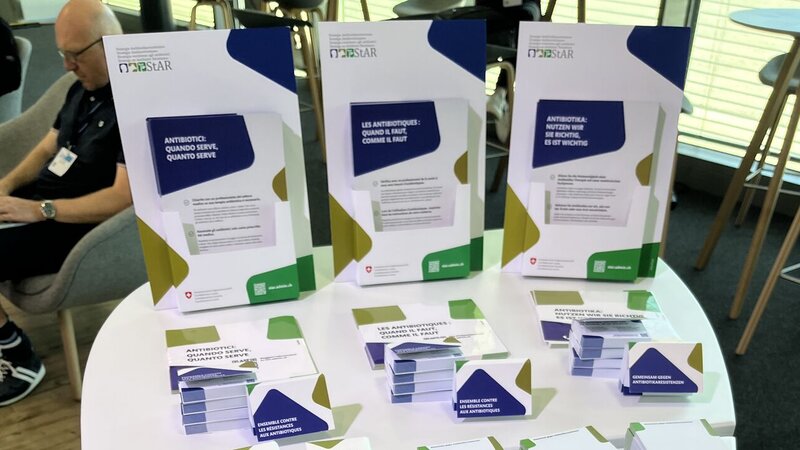
We were also represented at the congress to provide doctors with practical tools. At our information stand, we distributed materials on patient communication developed by the @FOPH, designed to support the dialogue between the prescribing doctor and the patient.
The gap between a good guideline and a change in prescribing practice is very real.